
Why Do Owls Hoot at Night: What Their Calls Mean
Discover why do owls hoot at night and what their calls mean, from attracting mates to defending territory and communicating with other owls after dark.
Owls hoot at night to communicate while they are active, with calls serving purposes such as holding territory and connecting with other owls. Territory is an area an owl defends for access to resources such as hunting grounds and nesting sites.
Hearing a call outside after dark can make an ordinary evening feel more connected to nature. That sound is usually part of owl communication, not a message about the people nearby. Its meaning depends on the caller and the moment, so a familiar hoot does not always signal the same thing.
The pitch, pattern, number of callers, and season help make sense of what a listener hears. A few details can turn an unexpected sound into a clearer picture of what is happening nearby.
Key Takeaways
- Calls help owls communicate after dark.
- Territorial claims and contact between birds are common reasons for calling.
- Pitch and rhythm can offer clues to the caller.
- Several callers may be answering one another.
- A call has no fixed spiritual meaning.
Why Do Owls Hoot at Night?
Night is when most owl species are active, so calling after dark lets them communicate during their working hours. Most species hunt or move at night, though some are more active by day or at dusk.
Low-light vision and sharp hearing help owls stay active after sunset. Owl eyes may be up to 100 times more sensitive in low light than human eyes. Their eyes are fixed in their sockets, so they turn their heads to look around. Great Horned Owls can swivel their heads more than 180 degrees.
Facial-disc feathers direct sound toward the ears, and hearing helps owls find prey. Some Barn Owls can catch mice using sound alone in a sealed, pitch-black environment. That does not mean owls can see in total darkness.
Even with excellent low-light vision and hearing, owls cannot see in complete darkness.
Specialized wing feathers help owls fly quietly, while asymmetrical ears help them locate prey by sound. These traits support hunting and movement when daylight is scarce. The low-light sensitivity of owl eyes makes twilight and nighttime useful, but not light-free, hunting conditions.
Even with excellent low-light vision and hearing, an owl still needs some light or sound cues to navigate and hunt.
What Do Owl Calls Communicate?
An owl’s call most often communicates with other owls, marking territory, attracting a mate, or warning an intruder. Both sexes vocalize, and the same bird may make different sounds in different situations.
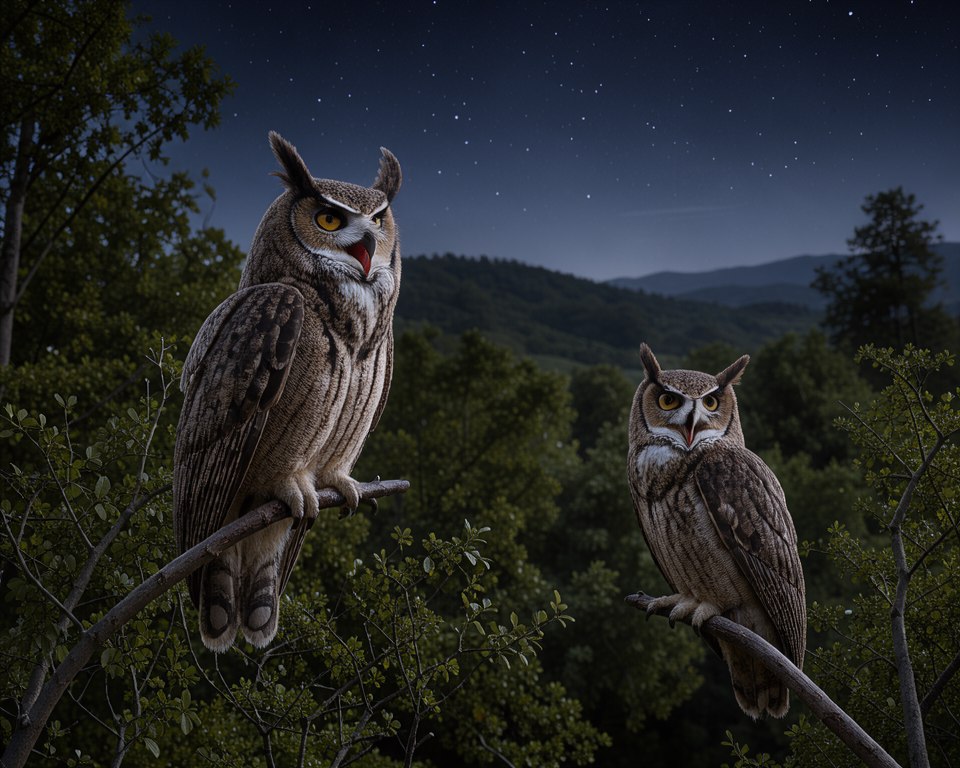
Territory Calls Mark a Boundary
Calls can tell nearby birds that an area is occupied. A territory gives an owl access to resources, including hunting grounds and nesting sites. Calling can also warn an intruder to keep away before a close encounter.
Territorial sounds do not always take the form of a smooth hoot. Harsh barks, growls, hisses, and bill snaps can signal agitation or defense. Young owls may whistle as they leave the nest in late spring and early summer.
Duets Connect a Pair
Pairs may call together in mating duets. The back-and-forth can reinforce a pair bond and signal territory ownership. One bird may call, then pause as its partner answers; the two voices can overlap or alternate.
A listener can focus on four clues without needing to identify every sound:
- Whether one owl or several owls are calling.
- Whether another caller answers.
- Whether the sound is a repeated hoot or a harsh call.
- Whether the calls form a back-and-forth duet.
These clues can help distinguish one caller from a pair. The role of paired calls includes both connection between partners and a signal to other birds.
Folklore Is Not a Biological Message
Three hoots do not have a fixed symbolic meaning, and hearing an owl at night has no established spiritual meaning. The sound is a form of communication, not a prediction about a listener or their family.
Folklore has attached different meanings to owl calls. Late-19th-century American accounts included a New York belief that an owl’s midnight cry foretold a friend’s death. Some Choctaw traditions assigned different death omens to calls from the Great Horned Owl, Screech Owl, and Barred Owl. Those accounts describe cultural beliefs, not reliable predictions.
A call’s rhythm and response pattern are more useful clues than assigning a fixed meaning to a particular number of hoots.
Recognizing Common Owl Calls
A deep, paired hoot points listeners toward a Great Horned Owl, while other familiar species have distinct calls. Pitch and pattern can help narrow the possibilities, though calls vary among individual birds.
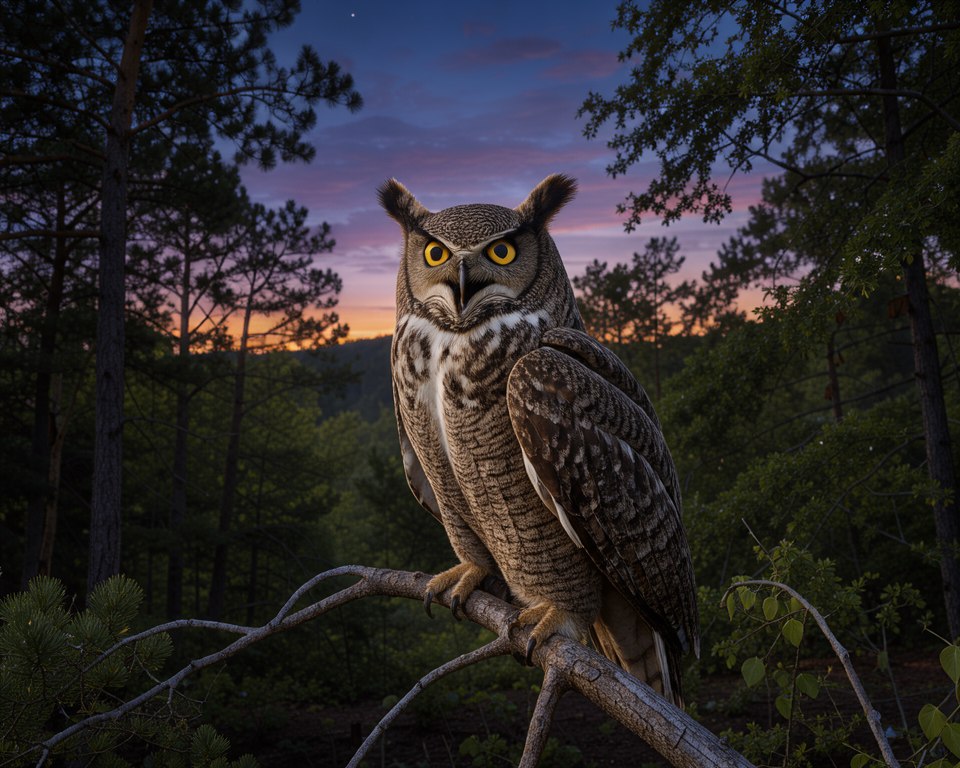
Male Great Horned Owls have deeper voices than females, even though females are larger. Great Horned Owl pairs often call together, with each bird’s voice differing in pitch. A listener may hear two distinct tones rather than one matching pair of hoots.
| Owl species | Recognizable sound | Listening clue |
|---|---|---|
| Great Horned Owl | Deep hoots and paired calls | Male’s lower pitch |
| Barred Owl | “Who cooks for you? Who cooks for you-all?” with cackles or gurgles | Recognizable phrase |
| Eastern Screech-Owl | Descending whinny or soft trills | Despite its name, it need not screech |
| Barn Owl | Harsh screech or hiss | Not a musical hoot |
The Barred Owl can also make cackles, gurgles, and caterwauling duets. Its familiar phrase is only one part of its sound range, so an unusual call does not rule it out.
Great Horned Owls are not the only horned owls listeners may encounter by name. In everyday descriptions, “great horned” often points to the same species, but a call alone may not confirm an identification.
Call descriptions are listening aids, not a guarantee that every caller will sound identical. Weather, distance, and the bird’s situation can change how a sound reaches the ear.
Compare the sound’s pattern and pitch with the caller’s likely habitat before settling on an identification.
When Do Owls Call Most?
Fall and late winter are important periods for owl calling because territory-setting leads into breeding activity. Calling can happen year-round, though the season and a bird’s behavior affect when listeners are more likely to hear it.
Fall and Late Winter Bring Seasonal Activity
In fall, owls establish winter territories and prepare for a late-winter breeding season. That change can make calls more noticeable as birds use familiar areas and contact one another.
Great Horned Owls are active year-round and are among the most common owls in North America. They may lay eggs in January, and they use old nests made by large birds such as hawks, ravens, and magpies instead of building their own.
| Time of year | Seasonal context | Possible listening clue |
|---|---|---|
| Fall | Owls establish winter territories | Calling as birds use an area |
| Winter and late winter | Preparation for breeding; Great Horned Owls may lay eggs in January | Calls may carry on cold nights |
| Spring and summer | Young owls grow and leave nests | Begging calls from young owls |
Nighttime Calls Can Start and Stop
A calling bout has no standard duration. An owl may call briefly or return to calling intermittently, and its behavior and situation affect how long it is heard.
Sound can be easier to hear on clear, cold nights. Summer foliage can muffle calls, while competing insect sounds may make them harder to pick out. A sound that seems louder in winter may simply have fewer obstacles between the caller and listener.
Call Duration Has No Fixed Schedule
There is no set number of minutes that owls hoot at night. One bout may end after a few calls; another may resume after a pause. The amount of calling depends on the owl’s behavior and context, so a quiet interval is part of ordinary listening.
Young owls may make begging calls in spring and summer. Those sounds can continue as the young birds become more independent and adults respond nearby.
A quiet stretch between calls does not mean an owl has left its territory.
What an Owl Near Home Means for People
An owl near a house is usually using the habitat or prey available there, not directing its call at the people inside. A useful yard may offer mice, other prey, trees, or a place to rest.
Great Horned Owls use habitats from wild areas to backyards and cities. They occur across North America in places ranging from deserts and wetlands to forests and grasslands. Their broad diet includes rodents, rabbits, skunks, and birds.
A Yard Can Offer Habitat and Prey
A yard can draw an owl when prey is available, even if the nearby homes are busy. Great Horned Owls may also hunt other owls, including Barn Owls. Golden eagles and northern goshawks prey on Great Horned Owls, too.
A Great Horned Owl can lift around its own body weight, about 2-3 lbs, not a 10 lb cat. A separate concern is nest defense: an owl may dive at a cat, dog, or person when a nest is nearby.
Keep Pets and Owls Safe
Four simple choices can reduce risks to pets and wildlife:
- Keep small pets supervised outdoors at night.
- Observe an owl from a respectful distance.
- Avoid rodenticides, which can poison owls that eat poisoned rodents.
- Avoid leaving outdoor lights on all night, since light pollution disrupts nighttime hunting.
If an owl dives near a person or pet, give the area around its nest more distance.
Great Horned Owls weigh 750-2,500 grams and have a wingspan of 101-145 centimeters. Their feet can close with 500 pounds per square inch of pressure, a reminder to avoid handling or approaching one.
If an owl dives near a person or pet, give the area around its nest more distance.
Conclusion
An owl’s nighttime call is usually a practical signal between birds, not a message intended for people. Pitch, pattern, season, and whether another owl answers give listeners useful context, while no single number of hoots explains every call.
A quiet moment outdoors can make the sound easier to notice. Listeners can pause from a distance and let the bird continue its routine without approaching or disturbing it.
The next time a call carries through the dark, listen for the pattern and let the owl keep its space.
FAQ
What other sounds do owls make?
Owls may screech, trill, hiss, bark, growl, or snap their bills, depending on the species and situation. Some calls are soft and musical, while others sound harsh or abrupt. Young birds can also whistle or beg for food. Those sounds are not all hoots, so listening for a call’s quality can help distinguish one type from another.
What is an owl’s worst enemy?
There is no single predator that threatens every owl species. Golden eagles and northern goshawks prey on Great Horned Owls, which can also face danger from other large birds. Great Horned Owls may prey on smaller owls, including Barn Owls. An owl’s risks depend on its species, size, age, and habitat.
How do owls see humans?
Owls see people using low-light vision, but they cannot see in total darkness. Their eyes are fixed in their sockets, so an owl turns its head to look around rather than moving its eyes. In dim conditions, an owl may notice movement or shapes without seeing every detail clearly. A person should keep a respectful distance.
What does it mean to hear an owl at 3am?
Hearing an owl at 3 a.m. has no fixed symbolic meaning. The call may help defend territory, contact a mate, or serve another form of communication. The hour alone does not reveal which purpose applies. The number of callers, the sound’s pattern, and whether another owl answers offer better clues than the time on a clock.
What does it mean when an owl is hooting outside your house?
An owl hooting outside a house is usually communicating with other owls, not addressing the people indoors. It may be defending territory, contacting a mate, or making another social call. Nearby prey or suitable habitat can make a yard useful to an owl. A call near a home does not, by itself, mean the bird is threatening residents.
Is it good to have owls in your yard?
Owls can be helpful neighbors because they prey on rodents and other animals. Their presence also means the yard offers food or habitat they can use. People can protect them by avoiding rodenticides, which can poison owls that eat poisoned rodents, and by giving the birds space. Owls are wild animals, so they should not be approached or handled.
Can an owl pick up a 10 lb cat?
A Great Horned Owl can lift around its own body weight, about 2-3 lbs, not a 10 lb cat. A different risk can arise if a cat gets close to a nest: an adult owl may dive to defend it. Keeping a small pet supervised outdoors at night helps reduce the chance of an encounter.
What scares owls at night?
Outdoor lights left on all night can deter nocturnal owls by disrupting their nighttime hunting. Bright, steady light may make a familiar feeding area less useful, especially when the owl depends on darkness to hunt. A dark yard is not a promise that an owl will visit, but avoiding unnecessary light can reduce one obstacle for a passing bird.