
Why Do We Have Christmas Trees: The History and Meaning
Learn why do we have christmas trees, plus the history, symbolism, and traditions behind this beloved holiday centerpiece in homes across America today.
People have Christmas trees because the modern custom combines winter greenery traditions with Christian practices, and the evergreen has become a seasonal symbol and gathering place. An evergreen is a plant that keeps its foliage through winter, even though individual leaves or needles may fall over time. The display brings light, color, and familiar decorations into homes during the darkest part of the season.
Today, the tree can be a religious symbol, a seasonal centerpiece, or a place where families gather. Its history reaches back through older winter customs and later Christian European home practices. Its meaning keeps changing as families add ornaments, stories, and rituals of their own.
Key Takeaways
- The modern custom draws on winter greenery and Christian European home practices.
- Evergreen foliage offers a visible sign of life during winter.
- Families give the display religious, seasonal, and personal meanings.
- The custom developed over time rather than beginning with one founder.
- A household can shape the tradition with its own decorations and rituals.
For many households, the display is both a seasonal symbol and a shared part of family life.
Why Do We Have Christmas Trees? Meaning and Symbolism
Christmas trees are special because their evergreen branches suggest life through winter, while Christian and secular families have given the display additional meanings. That living color can feel especially hopeful during a season when many plants lose their leaves. The tree can hold religious meaning, seasonal hope, and family memories at once.
Evergreens as signs of life in winter
Evergreen branches kept their color through winter, making them a striking contrast to bare trees and dormant gardens. Ancient Egyptians and Romans used greenery in winter customs, though those practices did not all lead directly to the Christmas tree tradition.
Romans observed Saturnalia in December, traditionally from December 17 through 23. December 25 was not a date for the pagan festival Saturnalia, though its connection to other Roman observances remains debated.
Older winter greenery customs are part of the background, not proof that every ancient display became a Christmas tree.
Christian meanings and modern secular use
For Christians, the tree may represent everlasting life and point toward the Nativity. Its lights and ornaments can also take on meanings tied to religious teaching or worship.
In secular homes, the tree often serves as a seasonal centerpiece, with decorations that recall favorite people, places, and years. Some households combine these meanings; others treat the display as a festive part of the winter season.
The tree’s symbolism can be religious, seasonal, or personal without being identical for every household.
Who Started the Christmas Tree Tradition?
No single person can be securely credited with starting the Christmas tree tradition, which took shape among Protestant Christians in Central Europe. The surviving records point especially to Germany and Livonia, but they document a custom spreading over time, not one inventor. The earliest records are evidence of decorated trees in different settings, not proof of a single first tree.
Medieval records in Central Europe
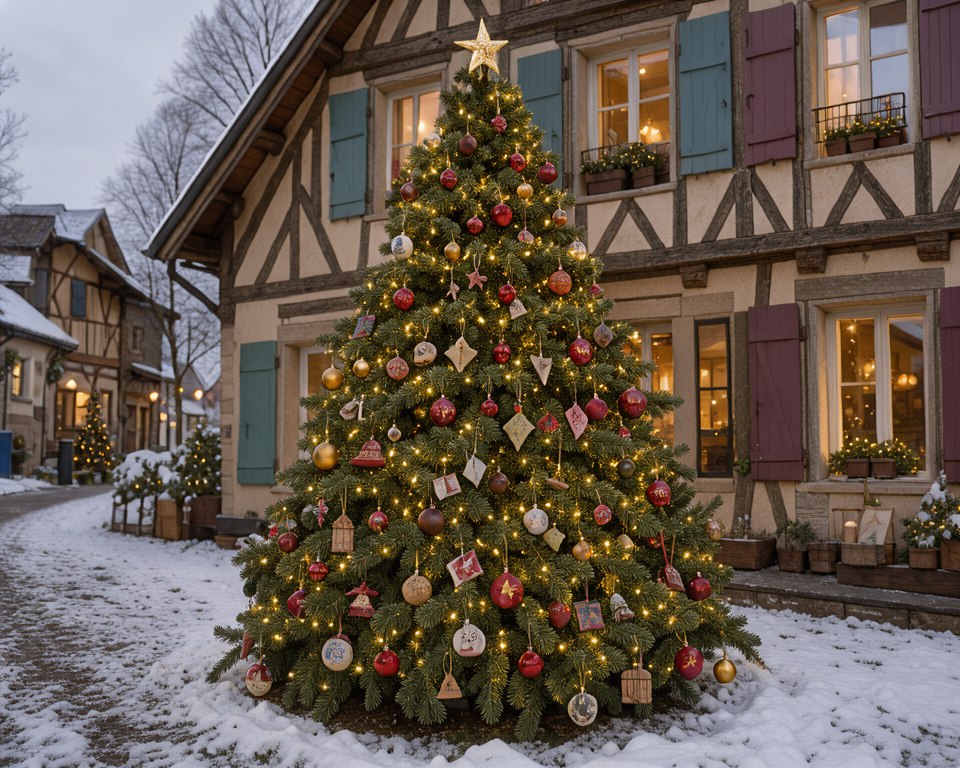
The Brotherhood of Blackheads, a guild association, erected holiday trees in its guild houses in Reval and Riga in 1441, 1442, 1510, and 1514. A Christmas tree was recorded in Strasbourg Cathedral in 1539. These accounts show that decorated trees appeared in more than one place.
A Bremen guild chronicle described a small decorated tree in 1570. The earliest firmly dated representation is a keystone sculpture on a private home in Turckheim, Alsace, from 1576.
| Date | Place | Record |
|---|---|---|
| 1441-1514 | Reval and Riga | Brotherhood of Blackheads guild-house trees |
| 1539 | Strasbourg | Tree recorded in the cathedral |
| 1570 | Bremen | Guild chronicle describes a decorated tree |
| 1576 | Turckheim in Alsace | Dated keystone sculpture |
The German household tree and the Martin Luther legend
By the 16th century, decorated trees were part of a developing Central European custom. The household tree became closely linked with German Christmas practices, though the surviving records do not identify one home as the starting point.
A popular legend credits Martin Luther with adding candles to a tree after seeing stars shining through evergreen branches. The story is memorable, but it is not a confirmed event. Candlelight remains part of the way some people picture an old-fashioned decorated Christmas tree.
The surviving records show a custom developing across places and decades, rather than a single documented invention.
How Christmas Trees Spread to the United States
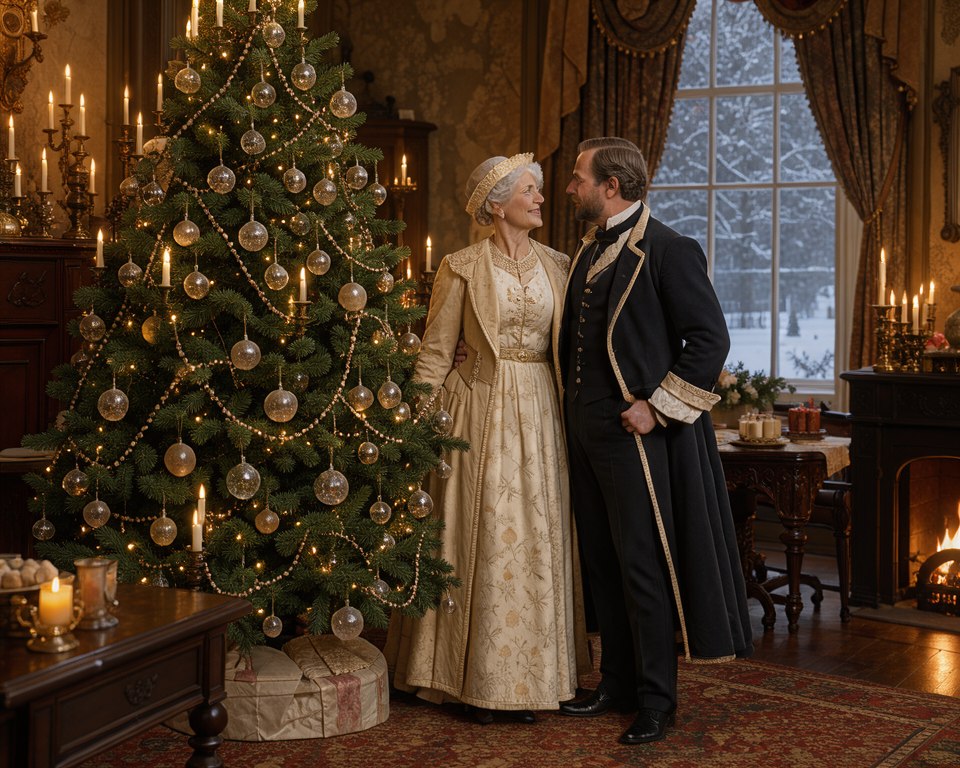
Queen Victoria and Prince Albert helped make the Christmas tree fashionable beyond royal homes after their 1848 Windsor display became widely known. Their tree gave the custom high-profile visibility in England, the United States, and Canada. Commercial U.S. sales began about 1850.
Royal visibility in Britain
Queen Charlotte had arranged a decorated yew tree at Windsor in 1800, decades before Victoria’s famous display. That earlier tree shows the custom had royal support, but it was the later scene of Victoria, Prince Albert, and their family that helped popularize Christmas trees widely.
The U.S. tradition takes root commercially
German immigrants brought familiar holiday customs with them, and commercial growers helped make trees available to more American homes. The market grew from small-scale sales into a crop raised for seasonal use. The following milestones trace that shift:
- Queen Charlotte arranged a decorated yew tree at Windsor in 1800.
- Victoria and Albert’s Windsor tree became widely noticed in 1848.
- Commercial Christmas tree sales began in the United States about 1850.
In 2022, U.S. farms cut more than 14.5 million Christmas trees, and growers sold $553 million in cut trees. The country also imported more than 3 million that year. About 30 million real Christmas trees are sold in the United States today.
Growers plan well ahead of the holiday: a tree takes an average of seven years to reach a typical height of 6 to 7 feet. A typical 6- to 7-foot tree represents an average of seven years of growing before it reaches the home.
Where Do Christmas Trees Grow, and How Do Customs Differ?
Christmas trees are grown commercially across all 50 states, although Oregon and North Carolina together account for more than half of U.S. trees cut in 2022. Nationwide cultivation makes the crop available in many regions, while production remains concentrated in those two states. About 16,000 U.S. farms grew commercial Christmas trees in 2022.
Growing regions across the United States
U.S. Christmas trees grow on roughly 350,000 acres, with farms planting about 900 to 1,700 trees per acre. Farms cultivate trees in every state, but climate, soil, and local growing conditions shape which evergreen trees thrive in each region.
Oregon and North Carolina together produced more than half of the trees cut in the United States in 2022. The 2022 farm count across all 50 states shows how broad the growing network is, even with production concentrated in a few leading states.
How countries shape their own tree customs
Christmas tree traditions differ around the world, shaped by local foods, religious practices, and familiar materials. In Germany, a home tree may be decorated in secret and revealed on Christmas Eve. In Mexico, a small arbolito can become part of a Nacimiento, or Nativity scene.
A Christmas tree drawing can use a tapered evergreen outline, layered branches, ornaments, lights, and a star or angel topper. Those familiar visual details help people recognize the holiday scene, but they do not establish where the custom began.
| Place | Tree or display | Custom |
|---|---|---|
| Germany | A home tree | Often decorated in secret and revealed on Christmas Eve |
| Mexico | An arbolito | Incorporated into a Nacimiento |
| Brazil | A pine | Decorated with cotton to suggest snow |
| Norway | A Christmas tree | Families sometimes circle it hand in hand and sing |
The familiar decorated fir is one expression of the tradition, not a universal template for holiday greenery.
How to Care for a Real Christmas Tree Safely
A fresh trunk cut, daily water checks, and a position at least 3 feet from heat help keep a real Christmas tree safer and fresher. A cut tree bought more than about 4-6 weeks before Christmas may not stay fresh through the holiday, especially in a warm room. A living tree with a root ball should stay indoors no more than 5-7 days.
Prepare the trunk and keep the stand watered
Before setting up a fresh cut tree, remove 2 inches from the trunk base. The National Fire Protection Association recommends this fresh cut before the tree goes into its stand. A stand should hold 1 quart of water per inch of trunk diameter.
Check the stand daily and keep the water above the trunk base. Most species can still take up water if the cut trunk goes into water within 6 to 8 hours of cutting. Water temperature does not affect uptake.
Drilling a hole in the trunk base does not improve water uptake. The trunk’s outer layers absorb water most efficiently, so whittling the sides to fit a stand can reduce the area that takes it up.
Reduce heat and electrical risks
Heat and electrical problems can turn a seasonal display into a fire hazard. Keep the tree away from fireplaces, heaters, heat vents, and direct sunlight. Use this short safety check when arranging the room:
- Place the tree at least 3 feet from heat sources.
- Switch off tree lights when leaving home or going to bed.
- Avoid overloading electrical circuits.
- Keep the tree away from direct sunlight.
Know when to remove the tree
U.S. fire departments responded to an annual average of 155 home structure fires caused by Christmas trees from 2018 through 2022. Those fires caused an annual average of four civilian deaths, seven civilian injuries, and $15 million in direct property damage. Electrical distribution or lighting equipment was involved in 41 percent of home Christmas tree fires.
Lamps or bulbs started 20 percent of those fires, and candles started 11 percent. Two in five began in the living room. Remove a cut tree after Christmas or as soon as it becomes dry, and never leave a dry tree in the home, garage, or against the house.
A living tree is different from a cut tree: its intact root ball needs moist roots, and it should return to a cool outdoor setting after a brief indoor stay. A Christmas tree should never be burned in a fireplace because it can contribute to creosote buildup.
How Christmas Trees Became Public Holiday Landmarks
Public Christmas trees turn a private seasonal custom into a shared landmark for a city or nation. Their decorations create a gathering point where neighbors and visitors can take part in the holiday season. Rockefeller Center’s tree began as a small, unadorned display in 1931.
Construction workers put up that first Rockefeller Center Christmas tree. By 1933, the tree had lights, adding a bright public scene to the city’s holiday calendar. Later displays grew into recognizable landmarks, drawing attention well beyond New York.
- 1931: Construction workers put up a small, unadorned tree.
- 1933: The Rockefeller Center tree had lights.
- 1999: A 100-foot Norway spruce from Killingworth, Connecticut, was displayed.
A separate public tradition began in 1923, when Calvin Coolidge started the National Christmas Tree Lighting Ceremony with a 48-foot balsam fir from Vermont. That ceremony established a national gathering around a decorated tree.
A public tree turns a familiar holiday decoration into a shared ritual beyond the home.
These displays make a holiday centerpiece part of public life as well as household tradition.
Conclusion
The Christmas tree endures because people have made an old seasonal custom meaningful in different ways. Its past includes winter greenery and Christian European home practices, while its present meaning can be religious, festive, or deeply personal.
No single interpretation has to fit every family. One household may choose ornaments tied to faith, while another may use decorations that recall a trip, a relative, or a favorite year.
A small ritual can make the display feel less like a decoration and more like a marker of time together. A family can choose one ornament or story to make this year’s display feel personal.
FAQ
How long can you keep a real Christmas tree in your house?
A cut Christmas tree commonly stays fresh for about 4-6 weeks when it is freshly cut and watered daily. Warm rooms can dry a tree faster, and different species may hold their needles for different lengths of time. Keeping the stand supplied with water helps the tree stay fresh, but it does not stop a tree from eventually drying out.
Can I leave my Christmas tree up all year after?
A real cut Christmas tree should be removed after Christmas or when it dries, while an artificial tree can be stored and reused. A dry cut tree becomes a fire hazard, so it should not remain in a home, garage, or against the house. Artificial trees do not need watering and can be packed away for another season.
Can I keep a Christmas tree alive for a month?
A cut tree cannot stay alive without roots, while a living tree with a root ball should spend only about 5-7 days indoors. Keep the root ball moist during its brief time inside, then return the tree to a cool outdoor setting. A living tree is meant for planting after the holidays, not for extended indoor display.
What happens if you don’t cut the bottom of a Christmas tree?
An old cut can reduce water uptake, so the National Fire Protection Association recommends removing 2 inches from the trunk base before placing a fresh tree in its stand. The new cut exposes the trunk’s water-absorbing layers. The stand still needs regular checks, since its water level must remain above the trunk base.
Can you plant a Christmas tree after it’s been cut?
A cut tree without its roots cannot be planted as a living tree; planting requires an intact root ball. Once a tree has been harvested for indoor display, it has no roots to support growth in soil. A living tree sold with its root ball is the option for a household that plans to plant it after the holiday.